Chapter : Work, Energy and Power
Topics in this chapter
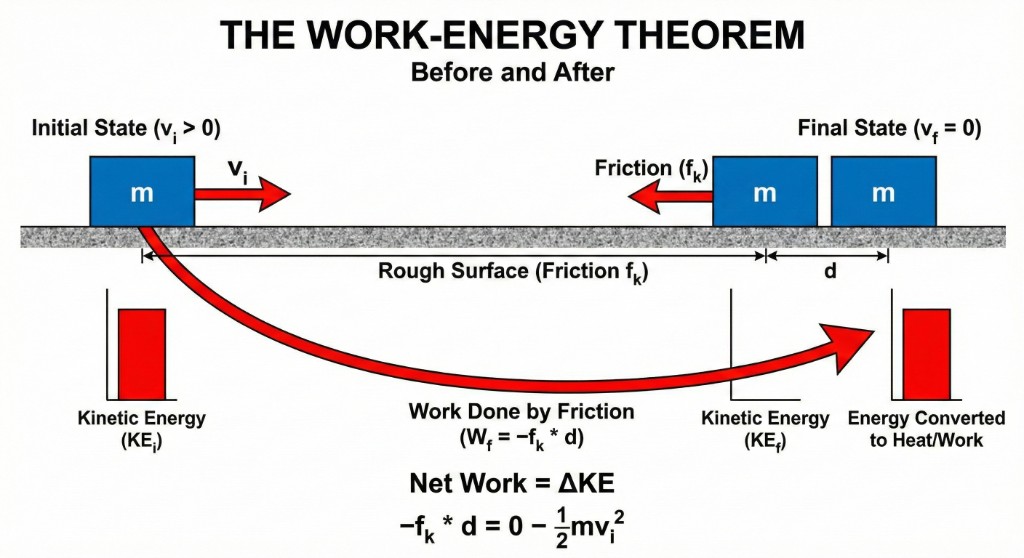
Understanding the Work-Energy Theorem
The Principle
The Work-Energy Theorem states that the net work done on an object equals its change in kinetic energy.
Wnet = ΔKE = KEf − KEi
Breakdown of the Diagram
- Initial State: The block starts with velocity vi, giving it Initial Kinetic Energy (KEi = ½mv²). This is shown by the full energy bar on the left.
- The Work Done: As the block slides, Friction (fk) acts opposite to the motion. It does negative work (W = −fk · d), effectively draining energy from the system.
- Final State: When the block stops, its velocity is zero, meaning KEf = 0.
Conclusion
The energy didn't disappear. The graphic shows that the Kinetic Energy lost is exactly equal to the Work done by friction (converted into heat and sound).